
Troubleshooting Guide
Strange Bakery Equipment Noises in Kenya: What They Mean
A new grinding, whining, humming, clicking, or hissing sound from an oven, mixer, slicer, or proofer is rarely random. Here’s how to read each one before it turns into a breakdown.

Kitchen staff who work around the same commercial bakery equipment every day tend to notice a change in sound almost immediately, even if they can’t yet name what’s wrong. That instinct is usually right, and it’s worth acting on. Long before a bearing seizes or a belt snaps outright, both give off an audible warning: a subtle knock, a rising whine, a hum that wasn’t there last week. Learning to read bakery equipment noises early is the difference between a fault you can schedule around and an unplanned shutdown mid-shift.
What makes noise diagnosis tricky is that identical sounds mean different things depending on the machine and where exactly they’re coming from. A grinding sound from an oven fan and a grinding sound from a mixer gearbox point to related but distinct issues. This guide to strange bakery equipment noises in Kenya walks through each sound on its own, so you can match what you’re hearing against the likely cause no matter which piece of equipment is making it, and judge how urgently it needs attention.
Sound As An Early Warning System
Very few mechanical failures happen all at once. Bearings degrade over weeks, belts lose tension gradually before they slip or tear, and electrical connections build resistance and heat long before a breaker finally trips. Each stage of that process has its own acoustic signature, which means a strange noise isn’t just an annoyance to ignore until it gets worse: it’s the machine actively telling you what’s failing. Owners of commercial bakery equipment in Kenya should also be aware that persistent loud equipment noise isn’t purely a mechanical concern; the National Environment Management Authority (NEMA) noise regulations extend to workplace environments, not just residential ones, which gives commercial kitchens one more reason to address a grinding or banging machine rather than working around it indefinitely.
Grinding Or Knocking Sounds
Grinding and rhythmic knocking are among the most common bakery equipment noises across nearly every machine category, and they almost always trace back to worn bearings. In oven and proofer fan motors, this usually shows up as a knock that speeds up or slows down in step with the fan itself. On dough mixers, grinding tends to originate in the motor or gearbox bearings and typically gets worse once the mixer is under load with a full batch. On slicers, a knock near the drive housing more often means bearing wear in the blade-bank assembly than any issue with the blade itself.
Bearing swaps are one of the more routine jobs a bakery equipment repair Kenya technician handles, and catching the fault at this early grinding stage generally means a single-visit fix rather than a full motor teardown.
High-Pitched Whining Or Squealing
A whine or squeal points to the drive belt far more often than the motor itself. A belt that’s slipping, glazed, or simply worn thin produces a high-pitched sound that typically climbs in volume once the machine is put under load: this shows up on mixers, slicers, and on any oven or proofer where the fan is belt-driven rather than direct-drive. A whine that only appears the instant a motor starts, rather than while it’s running, more often points to a weakening capacitor forcing the motor to work harder just to get moving.
Belt tension adjustment or replacement is usually a fast fix once a technician has the right part on hand, and a squealing belt is one of the most common bakery equipment noises we get called about, particularly on mixers and slicers.
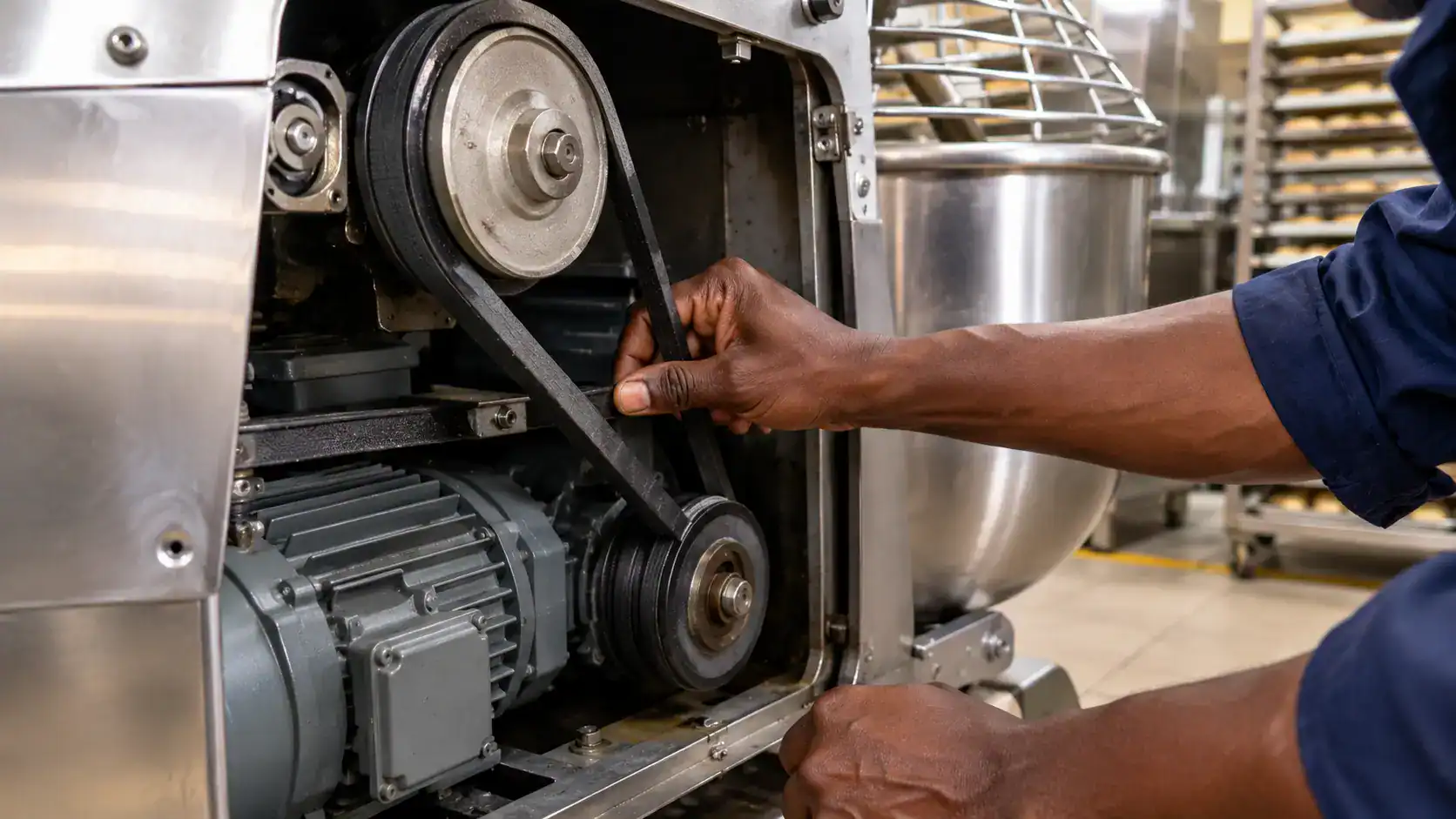
A Loud Hum With Little Or No Movement
Of all the unusual bakery equipment noises covered here, a loud hum with little or no shaft movement is the one to treat most seriously. If a motor is humming loudly but the shaft barely turns, or doesn’t turn at all, it’s straining against resistance it can’t overcome: usually a failing capacitor, a seized bearing, or, less commonly, a locked rotor. This is a different sound from a machine’s normal quiet operating hum. A loud, labored hum paired with little or no actual movement means the motor is pulling significant current while producing almost no useful output, and that combination generates heat fast.
This one isn’t a DIY fix. A motor humming under load without turning is drawing current it has no safe way to dissipate, and among unusual bakery equipment noises, it’s one of the clearest signs a motor is close to outright failure, worth an urgent call rather than a wait-and-see approach.
Clicking Or Ticking
Clicking is usually the least urgent of the bakery equipment noises on this list, though not always. A steady, evenly spaced click from a thermostat or relay cycling on and off is completely normal on most ovens and proofers. A new, irregular click or tap, especially one that lines up with the rotation of a fan, is a different story, and usually means a fan blade is making light contact with a guard or housing, typically because the blade has bent slightly or shifted out of position.
Fan blade realignment is a standard part of scheduled preventive maintenance visits, and catching it early avoids the blade bending further or scoring the housing over time.
Hissing Or Whistling
Of all the strange bakery equipment noises in this guide, hissing carries the highest safety stakes, and it means two very different things depending on the equipment. On gas-fired ovens, a hiss near a fitting or connection can indicate a gas leak, and that’s always treated as an immediate safety issue, never something to monitor and revisit later. On proofers, a hiss or whistle around the humidity system usually points to a steam line or fitting that isn’t fully sealed under pressure. Either way, hissing means something is escaping under pressure that shouldn’t be: gas in one case, steam in the other.
Gas-related hissing always warrants an emergency callout rather than any DIY attempt. Proofer humidity-system hissing is less urgent but still needs a technician’s eyes on it before it worsens.
Noise Quick Reference
The table below summarizes what each sound most commonly points to and how quickly it needs attention, drawn from the diagnostic pattern our technicians use whenever they investigate bakery equipment noises across Kenya.
| What you’re hearing | Most likely cause | Urgency |
|---|---|---|
| Grinding or rhythmic knocking | Worn bearings | Book a visit soon |
| High-pitched whine or squeal | Belt wear or slipping | Book a visit soon |
| Loud hum with little or no movement | Failing capacitor or seized motor | Stop use, call now |
| New irregular clicking in time with a fan | Fan blade contact with housing | Book a visit soon |
| Hissing with a gas smell | Gas leak | Emergency, stop use now |
| Hissing near a proofer humidity system | Steam line or fitting leak | Book a visit soon |
What To Handle Yourself, And What Needs A Technician
Listening closely, narrowing down where a sound is coming from, comparing it to how the machine normally sounds, and switching it off when something seems seriously wrong: all of that is safe to do yourself with most bakery equipment noises. Opening a motor housing, adjusting belts or bearings, or working anywhere near gas fittings should always be left to a professional. Accurate noise diagnosis over the phone genuinely helps: it often lets a technician arrive already knowing roughly what they’re dealing with, which tends to shorten the visit and keep the repair more affordable.
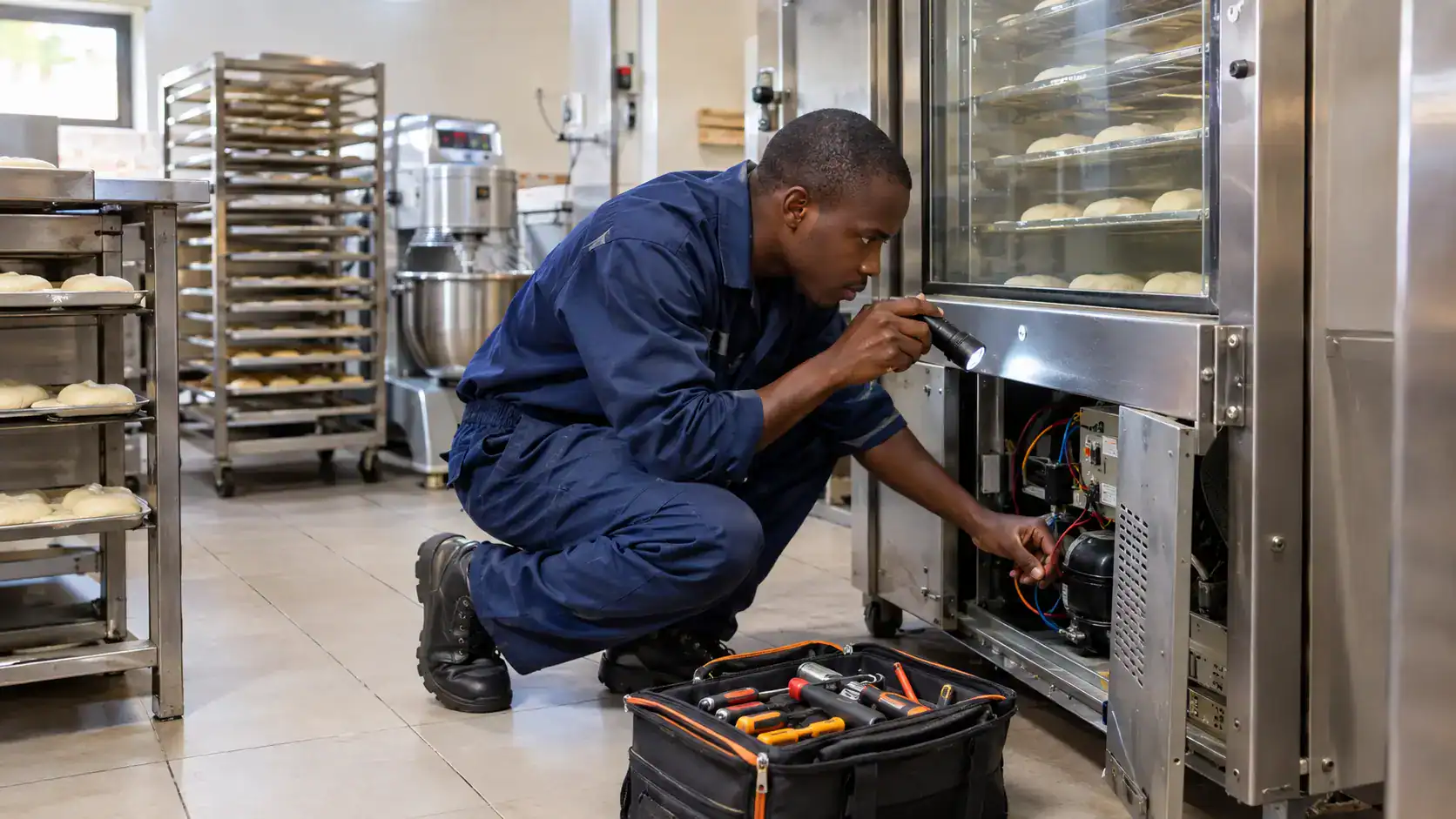
Heard Something You Can’t Place?
We handle bakery equipment repair Kenya wide, covering ovens, mixers, slicers, proofers, and every other piece of commercial bakery equipment keeping a kitchen running, and every visit starts with the same noise diagnosis approach outlined above. If your equipment has developed a new grinding, whining, humming, clicking, or hissing sound, our emergency repair service can get a technician to you quickly, or you can book a standard visit if it isn’t urgent yet. We also run scheduled preventive maintenance plans built to catch these sounds before they become a breakdown.
Frequently Asked Questions
Is any noise from bakery equipment normal?
Yes, most machines run with a low, steady hum or whir that’s completely normal. Unusual bakery equipment noises are defined by a change from that baseline: a new sound, a shift in pitch, or something getting louder over time, rather than sound itself being present.
Can I keep operating a machine that’s making a new noise?
For most mechanical sounds like grinding or whining, it’s usually fine to keep the machine running briefly while you book a visit, since these faults tend to worsen gradually. A loud hum with little movement, sparking, scorch marks, or any smell of gas should mean switching off immediately instead.
Does the same sound mean the same fault on every type of machine?
Largely yes for mechanical sounds like grinding and whining, since bearings and belts fail in similar ways across most equipment. Hissing is the exception: it’s far more urgent on a gas oven than on a proofer’s humidity system.
How much does bakery equipment repair Kenya cost for noise-related faults?
It depends on the specific fault, but bearing and belt repairs caught early are consistently cheaper than the motor or gearbox damage that can follow if a noise is left unaddressed, which is why an early diagnostic visit on commercial bakery equipment usually pays for itself.
Do you offer emergency callouts for unusual equipment noise?
Yes. Our emergency repair line is built for bakeries that can’t afford downtime, and a technician can typically reach you the same day within our service areas.
What should I do if I hear hissing and smell gas near my oven?
Shut off the gas supply if it’s safe to do so, ventilate the area, keep away from open flames or electrical switches nearby, and call for an emergency callout right away. This is never a situation to wait out.