
Troubleshooting Guide
A complete commercial oven repair Kenya diagnostic guide: five real causes, what to check yourself, and when to call a technician.
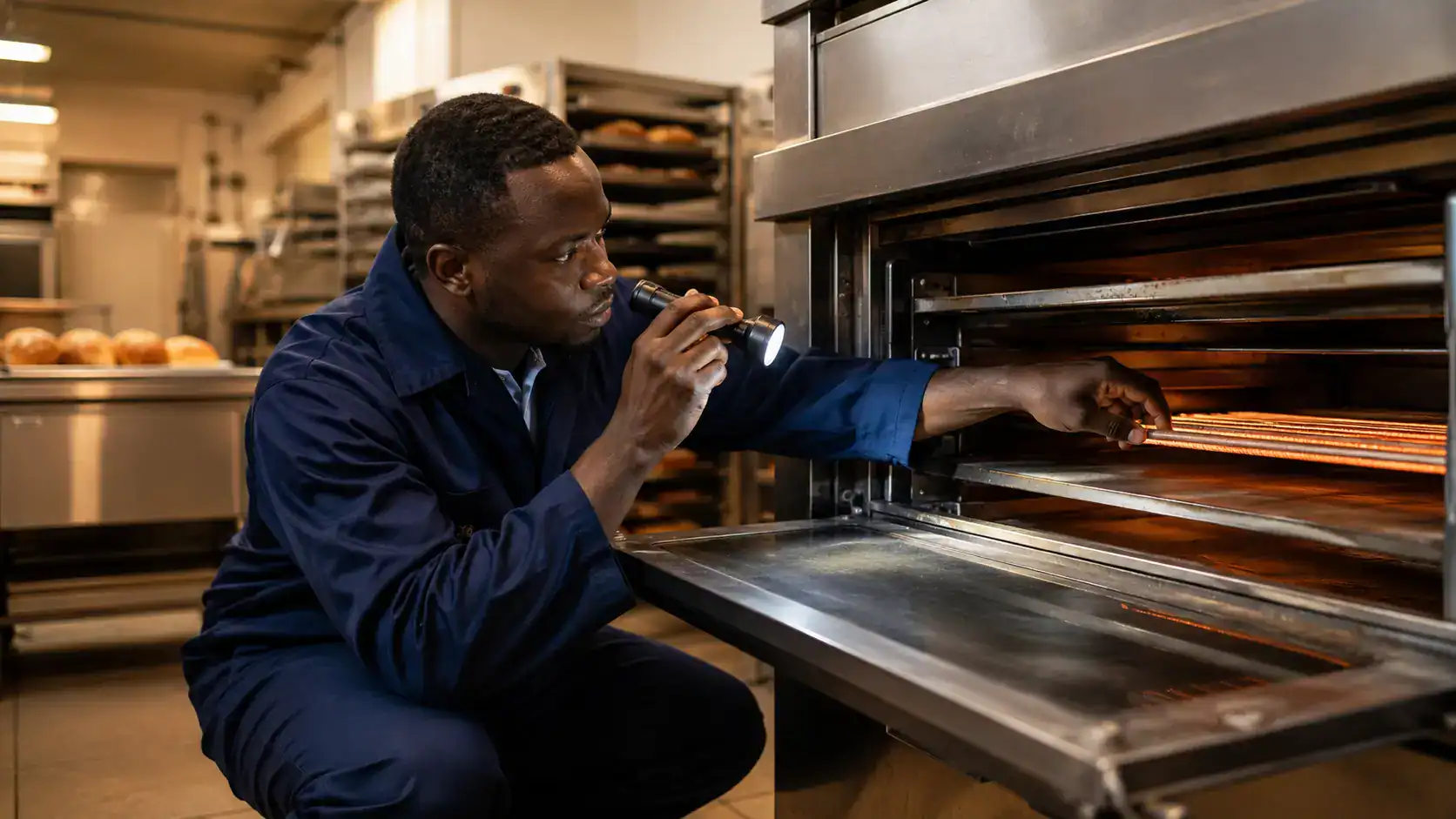
If your loaves are coming out golden on one side and pale on the other, or your cakes are burning at the back of the deck while the front stays underbaked, your oven is not just being difficult. Something inside it has failed, drifted out of calibration, or is being starved of the airflow or fuel it needs to heat the chamber consistently. Uneven heating is one of the most common reasons Kenyan bakeries book a commercial oven repair Kenya visit, and in most cases a commercial oven repair Kenya bakers can trust will fix the problem without replacing the whole unit. This guide explains exactly what a commercial oven repair Kenya technician checks first, so you know what to expect before anyone arrives.
This guide is longer and more detailed than most quick-tip articles on commercial oven repair Kenya bakers usually find, because uneven heating rarely has a single cause. Guessing wrong usually means wasted trays of product before you find the real problem. We will walk through how a commercial oven is supposed to distribute heat, the specific failure points that most commonly break that process, how to check each one safely, what it typically costs to leave the problem unaddressed, and exactly when a simple DIY check is fine versus when you need a qualified bakery equipment technician on site.
How A Commercial Oven Is Supposed To Heat Evenly
Before troubleshooting, it helps to understand what even heating actually depends on, because the fix is different depending on which part of the system has failed. Heat generation comes from electric elements or a gas burner producing the heat in the first place. Heat regulation is handled by a thermostat or temperature sensor telling the oven when to turn that heat on and off, keeping the chamber at a stable target. Heat distribution, in convection and rotary ovens, relies on fans moving hot air around the chamber so every shelf gets roughly the same exposure, while deck ovens depend instead on thermal mass. Heat retention depends on door seals, insulation, and chamber design keeping the heat that has been generated from escaping unevenly.
When bakery owners describe uneven heating, they are almost always describing a failure in one of these four stages. Knowing which stage is misbehaving narrows the cause down fast, which is the approach this guide takes below, and it is the same diagnostic approach our technicians use on every commercial oven repair Kenya bakeries book us for, whether the oven is electric or gas fired.
1. A Failing Or Unevenly Worn Heating Element
In electric deck and convection ovens, heating elements degrade over time, and they rarely fail all at once. One element can weaken or burn out while the others still work fine, creating hot and cold zones inside the same chamber that do not move even if you rotate your trays.
Elements are consumable parts. Repeated heating and cooling cycles cause the metal to expand and contract thousands of times over a unit’s life, eventually leading to hairline fractures, hot spots along the element itself, or full failure. Elements near the door or at the edges of a deck often wear faster because they cycle more aggressively to compensate for heat loss at those points.
Any time an element needs replacing, this is a job for a professional. It involves working with exposed electrical components, often at two hundred and forty volts or on three phase circuits for larger ovens, and is not something to attempt without the right isolation procedure and tools. This is one of the most frequent bakery equipment repair jobs our technicians carry parts for on the first visit, and it is the single most common call we get for commercial oven repair Kenya wide.
2. A Faulty Thermostat Or Temperature Sensor
The thermostat and its sensor are what tell your oven when to cycle the heat on and off. When the sensor drifts out of calibration, often gradually over months, the oven’s actual internal temperature stops matching what is shown on the dial or digital display, sometimes by twenty to thirty degrees or more.
Sensors sit directly in the heat path and are exposed to the same thermal cycling as the elements themselves, plus flour dust, steam, and grease over time, all of which can affect their accuracy. Digital control boards can also fail in ways that cause erratic rather than simply broken readings.
Recalibration is sometimes possible on site, but a full sensor or control board replacement needs a technician, especially on digital or programmable ovens where the fix involves the control electronics rather than a simple mechanical dial. This is a routine part of most commercial oven repair Kenya callouts, since sensor drift is often mistaken for a bigger fault than it actually is.
3. Poor Air Circulation In Convection And Rotary Ovens
Convection and rotary ovens rely on fans to distribute heat evenly across every shelf and around every tray. A weak, dirty, or partially blocked fan will still spin, which is why this fault is easy to miss, but it will not move enough air to keep temperatures consistent from top to bottom or front to back.
Fan blades accumulate flour dust and grease residue over time, which changes their aerodynamics and reduces airflow even at full speed. Bearings can also wear, causing the fan to run slower than its rated speed while still sounding largely normal. Overloading the oven with too many trays, or packing trays too close to vents, restricts airflow regardless of how well the fan itself is working, and it is one of the easiest causes to fix without calling anyone at all.

If cleaning and reduced loading do not resolve it, the fan motor, bearings, or blade assembly likely need professional inspection, which is a routine part of scheduled commercial oven maintenance visits, and a common line item on a commercial oven repair Kenya invoice for high volume kitchens.
4. Door Seal Damage
A worn, torn, or warped door gasket lets heat escape unevenly every time the door is opened, and even when the door is closed, gaps in the seal let heat leak out faster near the door than elsewhere in the chamber, creating a persistent cool zone at the front of the oven.
Door seals are made of heat resistant rubber or fiberglass rope that hardens, cracks, and compresses with age and repeated door slamming. High traffic bakery ovens that are opened dozens of times per shift wear seals faster than lower volume kitchens ever will.
Door seals are one of the more accessible DIY replacements on this list once you have the correct part for your exact model, but getting the wrong seal profile or size is a common and costly mistake, so it is worth having a bakery equipment technician confirm the part and fitting if you are not fully confident sourcing it yourself. A short commercial oven repair Kenya visit to confirm the correct seal part number can save you from ordering the wrong one twice.
5. Gas Burner Or Pilot Issues In Gas Fired Ovens
For gas fired ovens, uneven heating is often a burner problem rather than an insulation or element issue. An inconsistent flame, partially blocked gas jets, or an incorrect air-to-gas mixture will heat the chamber unevenly and waste fuel in the process, and in more serious cases points to an incomplete combustion problem that carries real safety risks beyond just baking quality.
Gas jets can become partially clogged with dust or residue over time, reducing and distorting the flame pattern. The air-to-gas mixture can drift out of adjustment, especially after a gas supply change or regulator issue. Pilot lights and thermocouples in older ovens can also weaken, causing the main burner to cycle unreliably, which is exactly why a proper gas oven repair Kenya technician will always start by inspecting the flame pattern before touching anything else.
This is always a job for a professional, never a DIY attempt. Gas systems carry real safety risks. Incomplete combustion can produce carbon monoxide, and incorrect adjustments can create leaks. Any reputable gas oven repair Kenya bakeries hire will always confirm gas safety certification once work is complete, which is worth asking about before booking anyone, and it is a standard step in every commercial oven repair Kenya job we complete involving gas components. Kenya’s Energy and Petroleum Regulatory Authority (EPRA) oversees LPG handling and installation standards nationally, and any technician working on your gas lines should be operating within those guidelines.
Quick Reference Table
The table below maps the symptom you are seeing to the most likely underlying cause, based on the diagnostic stages described above, and mirrors the checklist our team runs through on every commercial oven repair Kenya visit.
| What you’re seeing | Most likely cause |
|---|---|
| Same spot always underbakes, tray position doesn’t matter | Failing heating element (electric) or burner (gas) |
| Everything bakes hotter or cooler than the set temperature | Thermostat or sensor calibration |
| Top shelf bakes differently from bottom shelf | Fan or airflow restriction (convection/rotary) |
| Front of oven or items near the door underbake | Door seal damage |
| Yellow, flickering, or uneven flame | Gas burner or air-to-gas mixture issue |
| Temperature swings up and down during a steady bake | Sensor or control board fault |
The Real Cost Of Waiting
An oven that is heating unevenly is not just an inconvenience. It carries a compounding cost that is easy to underestimate. Wasted ingredients pile up on unevenly baked or rejected batches, which adds up fast at commercial volumes. Longer bake times used to compensate for weak spots increase gas or electricity consumption on every single batch. Inconsistent product quality affects customer trust and repeat business more than most bakery owners initially assume. Escalating failure risk is the biggest one: a struggling element, burner, or fan motor rarely fixes itself, and it typically fails completely at the worst possible time — mid-shift, during a high-demand period, or right before a large order. This is why so many bakeries eventually treat commercial oven maintenance as a scheduled cost rather than an emergency expense, because it is almost always cheaper in the long run than an urgent commercial oven repair Kenya callout during a busy week.
When To DIY Versus When To Call A Technician
It is safe to check door seals, tray loading and placement, general oven cleanliness, fan blade cleaning with the oven off and unplugged, and confirming actual temperature with an independent thermometer yourself. Anything involving heating elements, thermostats or sensors, control boards, internal wiring, fan motors, or any gas component should always go to a professional. This is not just about complexity. Working inside live electrical systems or gas lines without the right training and isolation procedure is a genuine safety risk, and an incorrect adjustment can turn a minor fault into a much more expensive bakery equipment repair, or damage the unit beyond repair entirely. When in doubt, a short commercial oven repair Kenya assessment is far cheaper than a mistake, and a qualified bakery equipment technician can usually tell you over the phone whether a callout is needed at all.
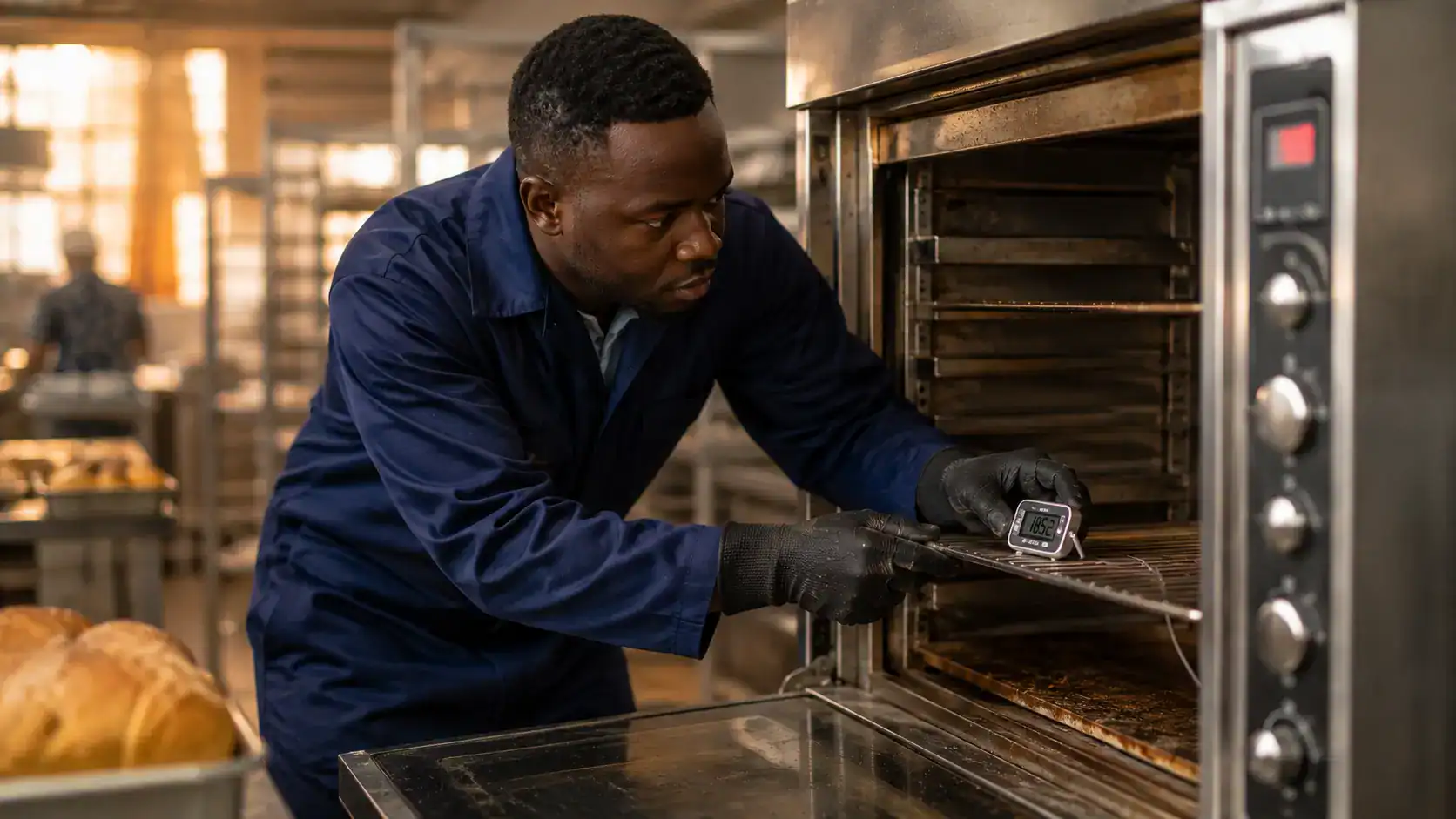
Get It Fixed Fast
Our technicians handle commercial oven repair Kenya wide, from deck and rotary ovens to gas fired and convection models, across bakeries of every size, and every visit follows the same commercial oven repair Kenya diagnostic process outlined above. If your oven is baking unevenly, running hot, or has stopped heating altogether, our emergency repair service gets a technician to you fast, or you can book a standard equipment repair visit if the issue is not urgent. We also offer scheduled commercial oven maintenance plans for bakeries that would rather prevent these breakdowns than react to them, and full equipment refurbishment for older ovens that are still worth saving.
Frequently Asked Questions
Can uneven heating damage my oven further if I keep using it?
Yes, in some cases. A single failing element working harder to compensate, or a burner running with an incorrect air-to-gas mixture, can accelerate wear on surrounding components and increase energy waste the longer it is left unaddressed, which is why most bakers eventually book a commercial oven repair Kenya technician rather than living with the problem, and why a small bakery equipment repair today is usually cheaper than a large one later.
How long does a typical oven repair like this take?
Simple fixes such as door seal replacement or fan cleaning can often be done in a single visit. Element, sensor, or gas component repairs depend on parts availability, but our technicians carry commonly needed parts for most standard commercial oven models used across Kenyan bakeries, which keeps most commercial oven repair Kenya jobs to a single visit rather than two.
Is it worth repairing an older oven, or should I replace it?
It depends on the specific fault and the age and condition of the unit overall, and this is exactly the kind of question worth getting an honest commercial oven repair Kenya assessment on rather than assuming either way.
How much does a commercial oven repair in Kenya typically cost for uneven heating issues?
Pricing depends on the fault, but most element, sensor, and seal repairs are far cheaper than replacing a whole oven, which is why an early commercial oven repair Kenya diagnostic visit usually pays for itself.
Do you offer emergency callouts for ovens that stop heating completely?
Yes. Our emergency repair line is available for bakeries that cannot afford downtime, and a bakery equipment technician can usually reach you the same day within our service areas for any commercial oven repair Kenya wide.
What areas do you cover for gas oven repair Kenya callouts?
We currently serve bakeries across Nairobi and the surrounding counties, with a bakery equipment technician dispatched from the nearest available team for both scheduled visits and emergencies.